
Haze Season Checklist for Singapore Homes: PSI vs PM2.5, N95 Masks and Keeping Indoor Air Clean
Haze is back and the group chat is panicking? A kiasu, fact-checked haze checklist for Singapore households — which reading to check (1-hour PM2.5 vs 24-hour PSI), what MOH says about N95 masks, what to stock at home, and how to keep indoor air cleaner, with Kiasu Ah Huat.
Updated 24 October 2026
The sky turns that familiar yellowish-grey, the void deck smells like someone is burning something, and the family group chat explodes: "PSI how much already?", "Got N95 or not?", "Should I let the kids go to school?" Haze season brings out the kiasu in all of us. But panic-buying ten boxes of masks isn't a plan. A checklist is.
Your guide once again is Kiasu Ah Huat, our (fictional) everyday Singaporean who reads the fine print so you don't lose out. Look out for "Ah Huat's Kiasu Tip" along the way.

When does haze usually happen?
Singapore doesn't have haze all year. The National Environment Agency (NEA) explains in its air pollution FAQs that transboundary haze mainly comes from forest and peat fires in the region, and haze is more likely during the Southwest Monsoon. The Meteorological Service Singapore (MSS) says the Southwest Monsoon runs from June to September, and that slight to moderate haze is common in this period. NEA's FAQs mention haze episodes in September 2015 and September 2019.
Ah Huat's Kiasu Tip: Do your haze prep in May, not in the middle of a bad week in September when everyone is queueing at the same shop.
Step 1: Know which number to check
This is where many people get confused. According to the Ministry of Health's haze advisory (last updated 21 October 2026):
- The 1-hour PM2.5 reading shows the current air quality. Use it for activities you're about to do now.
- The 24-hour PSI forecast is for planning next-day activities. A PSI reading of 101 and above is considered unhealthy.
For right-now decisions, MOH's personal guide uses four PM2.5 bands:
| 1-hr PM2.5 band | Healthy persons | Vulnerable persons |
|---|---|---|
| Band 1 Normal (0–55 µg/m³) | Continue normal activities | Continue normal activities |
| Band 2 Elevated (56–150 µg/m³) | Reduce strenuous outdoor activity for the next hour | Avoid strenuous outdoor activity for the next hour |
| Band 3 High (151–250 µg/m³) | Avoid strenuous outdoor activity for the next hour | Avoid all outdoor activity for the next hour; may wear a mask |
| Band 4 Very High (≥251 µg/m³) | Minimise all outdoor activity for the next hour; may wear a mask | Avoid all outdoor activity for the next hour; may wear a mask |
Where to check: NEA's FAQs point to the myENV app and haze.gov.sg, and readings are reported for five regions of Singapore. NEA also notes that 1-hour PM2.5 readings can be volatile, so don't make big decisions on one spike.
Step 2: Understand what haze does to healthy people
MOH says that for healthy individuals, short-term exposure over a few days generally won't cause major health issues, other than irritation of the eyes, nose and throat. Unless the 1-hour PM2.5 is in Band 4 or the PSI forecast is hazardous, it's generally safe for healthy people to carry on with outdoor activities in most cases, at reduced intensity or duration, and you should drink plenty of water.
Step 3: N95 masks, the facts (not the panic)
From MOH's advisory:
- N95 masks (or equivalent) are not needed for commuting from home to school or work, and not needed indoors.
- MOH lists KN95, FFP2 and KF94 as equivalents; the different names reflect different national standards.
- The mask must fit properly: correct size, covering nose and mouth comfortably without leaks.
- Masks can be reused but not shared, as long as they're not soiled, damp, damaged or out of shape.
- The elderly, pregnant women and people with severe lung or heart problems should check with a doctor before using one. Women in the 2nd and 3rd trimesters shouldn't use one for long durations.
- Anyone who feels discomfort should take a break from the mask.
- For the general public, if PM2.5 is above 250 µg/m³ and you have to be outdoors for several hours, MOH advises wearing an N95 or equivalent.
And what about the surgical masks you already have? HealthHub says normal surgical masks are not effective in filtering fine particles, though they can reduce discomfort from larger irritant particles.
For children, MOH notes there are currently no international certification standards for children's masks, and the key precaution is to follow the haze advisory when planning outdoor activities.
Ah Huat's Kiasu Tip: Buy a few N95s in the size that actually fits each adult at home, and try them on before haze season. A mask that leaks at the sides is just a very expensive surgical mask.
Step 4: Prepare your home
HealthHub's household tips:
- When outdoor air quality worsens, close doors and windows to reduce how fast haze particles get in.
- Minimise indoor pollutants such as smoking.
- Re-open windows and doors when outdoor air improves.
- Fans and aircon can be used for circulation and cooling. If your aircon draws in unfiltered outside air (for example, a window unit), close the outdoor air intake.
- Portable air purifiers can further reduce indoor particle levels.
NEA's practical tips for managing indoor air during haze add a few things worth knowing:
- Wet-clean (mop or wipe) to remove settled dust, instead of sweeping it back into the air.
- A closed-up room can build up heat and carbon dioxide, so ventilate periodically when outdoor air improves.
- Air purifiers may not reach their rated performance if doors and windows are open.
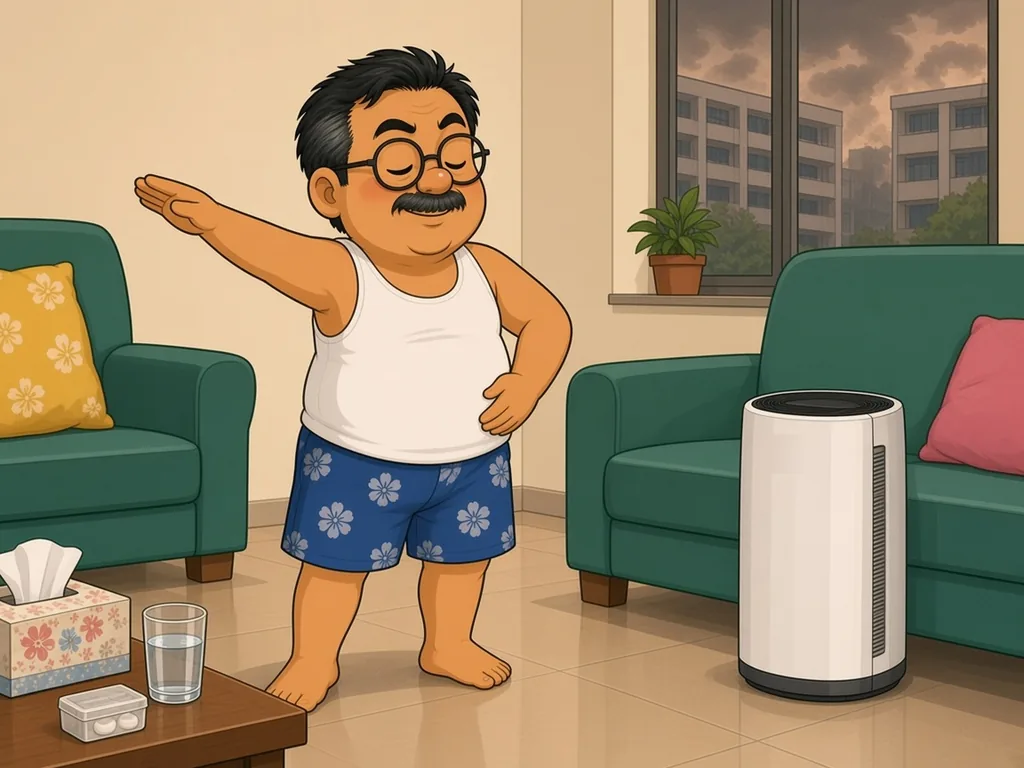
Step 5: Medications and health
- MOH says people with chronic heart and lung conditions should make sure their medications are on hand and readily available.
- HealthHub says vulnerable persons who develop symptoms or feel unwell should seek medical attention promptly.
- MOH's page also describes the Haze Subsidy Scheme, which helps Singaporeans with haze-related medical needs at participating Public Health Preparedness Clinics and all polyclinics. Check MOH's page for details when haze hits.
What about an air purifier?
If you're buying one, choose it before haze season, not during. For haze, NEA suggests looking at a purifier with a HEPA filter and checking the smoke CADR against your room size. Ah Huat goes through CADR, true HEPA vs "HEPA-type", ionisers, noise and filter costs in his guide to choosing an air purifier.
Our picks
Paiseh, no pick yet. We haven't tested air purifiers or masks hands-on. We're researching and comparing models from spec sheets and owner reviews before we recommend anything for Singapore homes. Rather than show a placeholder link, here's where our recommendation will go:
Product pick coming soon
We'll add a recommendation here once we're confident in it.
Pros
- Recommendation coming soon
Cons
- Not yet published — check back soon
Ah Huat's haze-season checklist
Screenshot this and send it to the family group chat — Ah Huat would.
- Install myENV and bookmark haze.gov.sg.
- 1-hour PM2.5 for now; 24-hour PSI forecast for tomorrow.
- A few well-fitting N95s (or KN95, FFP2, KF94) per adult; try them on early.
- No N95 needed for the commute or indoors (MOH).
- Medications stocked for anyone with heart or lung conditions.
- Close windows when air worsens; close the aircon's outdoor air intake if it has one.
- Mop and wipe, don't sweep.
- Air purifier? Check HEPA and smoke CADR before haze season.
- Drink water, and follow the latest MOH advisory.
Looking for more? Ah Huat has also done his homework on air purifiers and dehumidifiers. Get these right and your home stays shiok — even when the sky isn't.