
Fan vs Air Cooler vs Aircon: How Much Does Staying Cool Really Cost in Singapore?
Scared of the SP bill every month? A kiasu, fact-checked guide to working out what your fan and aircon really cost at the Q4 2026 tariff — how to read NEA's energy label, rescale its cost to today's rate, NEA's aircon savings tips, and why an air cooler struggles in Singapore humidity, with Kiasu Ah Huat.
Updated 24 October 2026
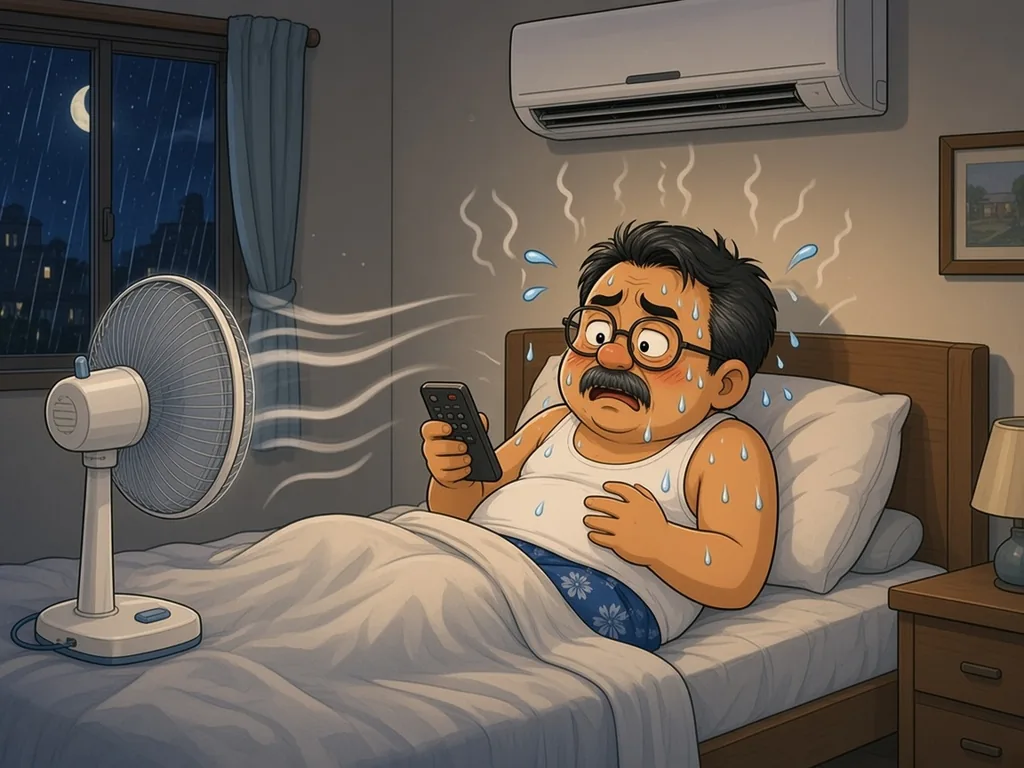
It's 11pm, the bedroom feels like a sauna, and Ah Huat is lying in bed holding the aircon remote like it's a winning 4D ticket he's scared to cash. Switch it on, and the SP bill goes up. Don't switch it on, and he sweats all night. The standing fan whirs beside him, judging.
Your guide once again is Kiasu Ah Huat, our (fictional) everyday Singaporean who reads the fine print so you don't lose out. Look out for "Ah Huat's Kiasu Tip" along the way. Today's mission: stop guessing, start calculating.
Step 1: Know your electricity rate
SP Group lists the household electricity tariff for 1 October to 31 December 2026 as 31.16 cents per kWh including GST (28.59 cents before GST). In its media release of 30 September 2026, SP Group said it reviews tariffs every quarter based on guidelines set by the Energy Market Authority. The Q4 2026 household tariff fell by 10.4% (3.32 cents per kWh before GST) from the previous quarter, but SP Group said global fuel prices have risen since September 2026 and, should this persist, tariffs are expected to increase the following quarter. So always plug in the latest rate.
The basic formula:
watts ÷ 1,000 × hours = kWh, then kWh × 31.16 cents = cost
Step 2: A fan's running cost
NEA's own energy-saving tips assume a 50 W fan in their calculations. Using that figure as an example:
- 50 W × 8 hours = 0.4 kWh a night
- 0.4 kWh × 31.16 cents ≈ 12.5 cents a night
- Every night for a year ≈ $45
That's an illustration using NEA's assumed wattage, not a specific product. Check the rated wattage on your own fan's label or manual and redo the maths.
NEA's Resource Efficiency Guide for New Home Owners says using a fan instead of an air-conditioner "can save you $460 a year!" — based on electricity at $0.27 per kWh, so at today's higher rate the saving would be larger. The same guide says ceiling fans are more effective than standing fans for cooling.
Ah Huat's Kiasu Tip: A fan only cools you, by moving air over your skin. Leaving it spinning in an empty room is just paying to stir air.
Step 3: Reading the aircon energy label (the kiasu way)
Air-conditioners in Singapore carry NEA's energy label. NEA's energy label page explains what's on it:
- Ticks — more ticks mean more energy efficient.
- Annual energy consumption in kWh, for air-conditioners based on 8 hours' daily use plus 16 hours on standby.
- Annual energy cost, for air-conditioners based on 27 cents per kWh, 8 hours' daily use and 16 hours on standby.
- A disclaimer that applies to all appliances: "Actual energy consumption and cost may vary."
Here's the catch: the label's dollar figure uses 27 cents per kWh, but the Q4 2026 tariff is 31.16 cents. To update it:
- Easiest: label kWh × 31.16 cents. A hypothetical label showing 1,000 kWh a year would come to about $311.60 at today's rate.
- Or: label cost × 31.16 ÷ 27, which is roughly × 1.15.
And remember the label assumes 8 hours a day. If you run it 4 hours, roughly halve it; if 12 hours, scale up.
Two more facts from NEA's MELS and MEPS page: the minimum energy performance standard for single-split air-conditioners was raised to 4 ticks on 1 April 2025 (5 ticks for multi-split), and portable air-conditioners have been under the labelling scheme since 1 April 2024, rated from 1 to 2 ticks.
Step 4: Using the aircon smarter
NEA's energy-saving tips:
- Set the temperature at 25°C. For every degree raised, you can save about 3% of utility costs.
- Set the timer to turn off half an hour earlier than usual — the room stays cool for a while. Saves about 2%.
- Check the air filter monthly and clean or replace it when needed, and get the unit serviced regularly and inspected annually.
- Close curtains or blinds in the hottest part of the day.
NEA bases these on $0.29 per kWh before GST, a single-split 4-tick 2.6 kW air-conditioner and a 50 W fan. The fan-instead-of-aircon (26%) and aircon-then-fan (23%) savings are in Ah Huat's guide to choosing a fan or air cooler.
And the air cooler?
Ah, the "cheap aircon" that's actually not an aircon. The US Building America Solution Center (BASC) says evaporative coolers add humidity to the air and work best in dry climates — where they can use about a quarter of the energy of central air-conditioning. But at 100% relative humidity, evaporative cooling can't happen at all, and for humid climates BASC recommends standard air-conditioning, which also dehumidifies.
Singapore's air is anything but dry. The Meteorological Service Singapore says relative humidity averages around 82%, is often above 90% in the early morning, and often reaches 100% during prolonged rain.
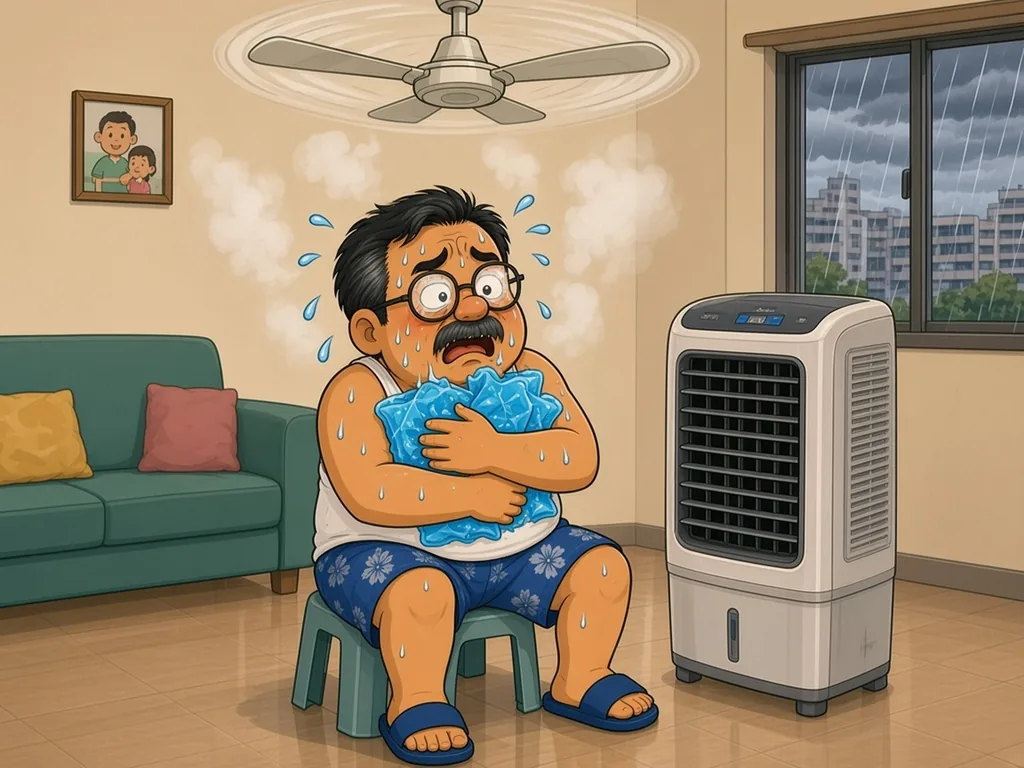
So an air cooler's electricity use is only half the story. In muggy weather it may not cool you much more than a fan does, and it adds moisture to the room. BASC also warns standing water in a cooler can breed mosquitoes and Legionella, so empty and clean it.
Head-to-head
| Fan | Air cooler (evaporative) | Aircon | |
|---|---|---|---|
| What it does | Moves air; makes you feel cooler | Cools air by evaporating water; adds humidity | Cools and dehumidifies the air |
| Running cost example | NEA's 50 W fan, 8 h ≈ 12.5 cents at 31.16 c/kWh | Check its rated wattage | Label kWh × 31.16 cents (label assumes 8 h a day) |
| In Singapore humidity | Works by air movement either way | Weakest when humid; none at 100% RH | Works, and removes moisture |
| NEA energy label | Not among the appliances on NEA's labelling page — check rated wattage | Not among the appliances on NEA's labelling page — check rated wattage | Yes — ticks, kWh and cost |
| Watch out | Switch off when you leave the room | Standing water: mosquitoes, Legionella | Set 25°C, use the timer, clean the filter |
Ah Huat's verdict
- Fan first. Cheapest to run. Ceiling fans beat standing fans, says NEA.
- Aircon when you need it — at 25°C with a timer, and a fan after.
- Air cooler: honestly, think twice in Singapore humidity.
Our picks
Paiseh, no pick yet. We haven't tested fans, air coolers or air-conditioners hands-on. We're researching and comparing models from spec sheets and owner reviews before we recommend anything for Singapore homes. Rather than show a placeholder link, here's where our recommendation will go:
Product pick coming soon
We'll add a recommendation here once we're confident in it.
Pros
- Recommendation coming soon
Cons
- Not yet published — check back soon
Ah Huat's cost-cutting checklist
Screenshot this and stick it beside the aircon remote — Ah Huat would.
- Check the latest SP tariff each quarter (Q4 2026: 31.16 c/kWh with GST).
- Formula: W ÷ 1,000 × hours × tariff.
- Aircon label cost uses 27 c/kWh — multiply by about 1.15 for today.
- Aircon at 25°C; every degree up saves about 3% (NEA).
- Timer off 30 minutes early — about 2% saved.
- Clean the aircon filter monthly.
- Fan off when you leave the room.
- Air cooler? Remember the humidity, and empty the tank.
Looking for more? Ah Huat has also done his homework on fans and air coolers and dehumidifiers. Get these right and your home stays shiok — and so does your wallet.