
How to Choose a Fan or Air Cooler in Singapore (HDB & Condo Guide)
A kiasu, no-nonsense guide to fans and evaporative 'air coolers' in Singapore — table, standing, tower, ceiling and bladeless fans, why air coolers struggle in our humidity, the SAFETY Mark, saving electricity versus the air-con, and keeping water tanks mosquito-free, with tips from Kiasu Ah Huat.
Updated 24 October 2026
It's 2pm, the rain has stopped, and your flat feels like a steamboat. The air-con bill last month already made you pengsan, so you go hunting for a fan. At the electrical shop there are tower fans, bladeless fans, "air circulators", and a row of "air coolers" with ice packs and water tanks that promise "cool like air-con, cheap like fan". Which one actually works in Singapore weather? Before you carry one home, let's sort out the facts, so you don't kena con.
Your guide once again is Kiasu Ah Huat, our (fictional) everyday Singaporean who reads the fine print so you don't lose out. Look out for "Ah Huat's Kiasu Tip" along the way.
First, understand Singapore's air
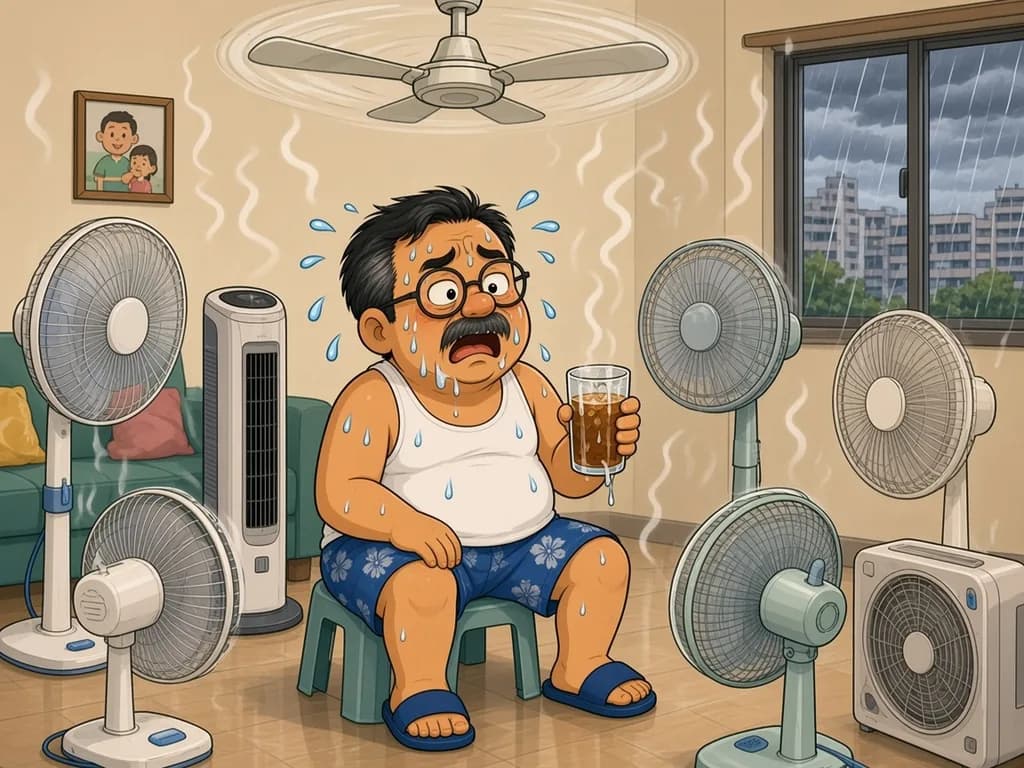
According to the Meteorological Service Singapore, Singapore has high humidity all year round. Relative humidity goes from more than 90% in the early morning to around 60% on rain-free afternoons, the annual mean is around 82%, and it often reaches 100% during prolonged rain. Keep that in mind, because it matters a lot for air coolers.
How a fan cools you (and what it can't do)
A fan doesn't make the air colder. The US Building America Solution Center (Pacific Northwest National Laboratory) explains that ceiling fans create air movement that can encourage evaporation and make people feel cooler, but they can't cool, filter or dehumidify the air. It also points out that a fan only improves comfort if someone is there to feel the air moving. So switch it off when you leave the room.
Fan vs air-con: the savings
Here's where a fan shines. NEA's energy-saving tips say:
- Using a fan instead of an air-conditioner saves about 26% of utility costs.
- Running the air-con for about an hour, then switching to a fan, saves about 23%.
These figures assume electricity at $0.29 per kWh before GST, a 4-tick air-conditioner of 2.6kW cooling capacity and a 50W fan.
Ah Huat's Kiasu Tip: Ah Huat's bedtime routine: air-con for the first hour, then fan for the rest of the night. NEA's numbers back him up.
Types of fans
| Type | Good for | Things to know | SAFETY Mark? |
|---|---|---|---|
| Table / desk | One person at a desk or bedside | Small, portable | Yes |
| Standing / floor | Bedrooms, living rooms | Height adjustable on many models | Yes |
| Tower or bladeless | Narrow spaces | Check how easy the parts are to clean | Yes (CPSO lists both as examples) |
| Box or air circulator | Moving air across a room | Direct it where people are | Yes (CPSO lists both as examples) |
| Wall or ceiling | Rooms where floor space is tight | Needs secure mounting; ceiling fans also need wiring | Yes |
| Portable misting fan | Outdoor or semi-outdoor spots | Adds water spray to the air | No: CPSO lists it as not a Controlled Good |
Look for the SAFETY Mark
Fans are on the Consumer Product Safety Office's list of Controlled Goods, covering ceiling, table, standing and wall fans for household use. CPSO's information booklet gives tower, bladeless, box, air circulator, clip-on and other fans as examples, and lists portable misting fog fans as not Controlled Goods. Air coolers are on the list too: household appliances that move the air and use water as the cooling medium.
According to CPSO's SAFETY Mark page, Controlled Goods must be tested and carry the SAFETY Mark before they can be sold in Singapore. Each mark has a unique 8-digit registration number that you can check at go.gov.sg/safety-mark. Appliances with a 3-pin plug need two SAFETY Marks: one on the appliance and one on the plug.
Ah Huat's Kiasu Tip: Ceiling fans are wired into your home, not plugged in. Get a qualified electrical worker to install one, follow the manual, and check the fan's SAFETY Mark before the installer arrives.
Choosing a ceiling fan
BASC's ceiling fan guide has a few useful points:
- High-efficiency fans use permanent magnet motors, which are 3 to 5 times as efficient as standard ceiling fan motors.
- For a damp spot like a balcony or service yard, choose a fan rated for wet or damp locations.
- Compare the airflow per watt on the maker's spec sheet, rather than just the size or the look.
There's no NEA tick label for fans: according to NEA's MELS and MEPS page, the Energy Label covers specific appliances such as air-conditioners, refrigerators, clothes dryers, televisions, lamps and water heaters. So check the rated wattage on the spec sheet.
"Air coolers": the honest truth for Singapore
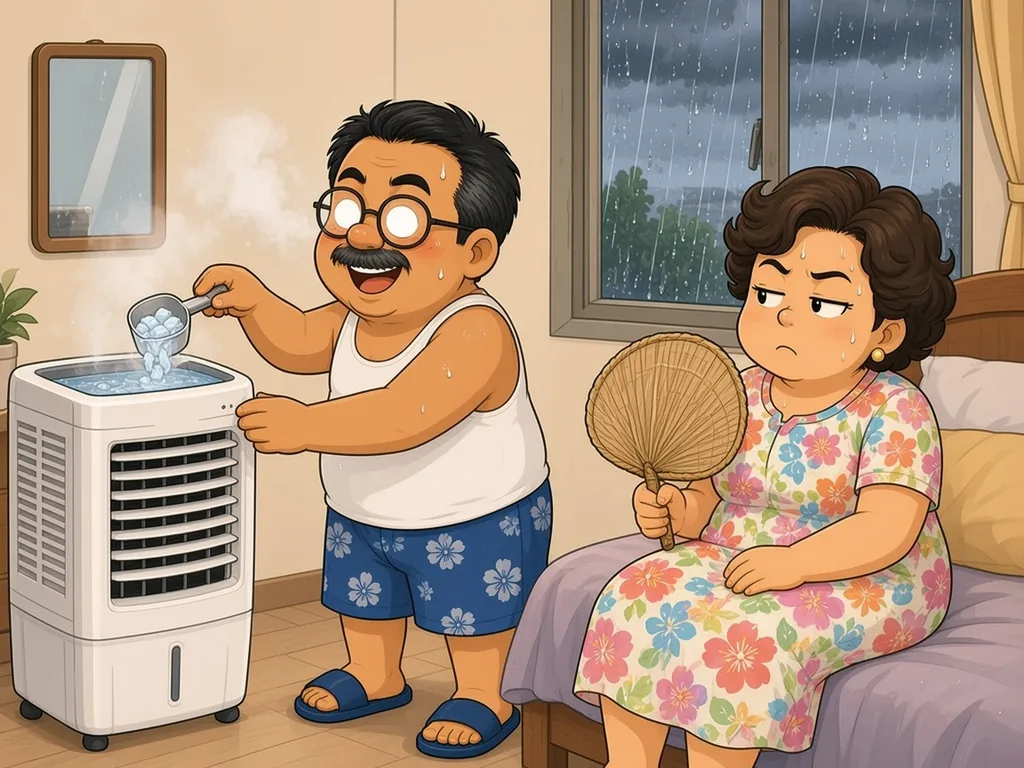
An evaporative "air cooler" blows air through a wet pad or over water. The water evaporates and the air coming out feels cooler. But according to BASC, direct evaporative coolers increase rather than decrease the humidity in the air, and they work best in dry climates. The more humid the air, the less cooling you get, and at 100% relative humidity evaporative cooling cannot occur at all. For humid climates, BASC recommends standard air-conditioning or heat pumps instead, which also dehumidify.
The US Geological Survey says the same thing: evaporative coolers work best in dry areas, while in the humid eastern US normal air conditioners must be used. These sources describe home cooling systems in the United States, but the physics of evaporation is the same for a portable air cooler in your living room.
So in Singapore, with average humidity of around 82%, expect an air cooler to work at its weakest exactly when it's muggy. It also adds moisture to the room. If damp and mould are already a problem at home, that's the opposite of what you want.
Ah Huat's Kiasu Tip: Before buying an air cooler, ask the shop: "How does it do on a rainy afternoon?" If the honest answer is "not much better than a fan", then buy the fan and save the money.
Keep any water tank clean (mozzie alert)
If you do get an air cooler, or a misting fan, the water tank needs attention. NEA says Aedes mosquitoes breed in clean, stagnant water easily found in our homes, and advises checking for and removing stagnant water often. BASC also warns that standing water left in an evaporative cooler can become a breeding ground for mosquitoes and bacteria, including Legionella. Empty the tank when the unit will sit idle, and replace torn, worn or mildewed pads.
Our picks
Paiseh, no pick yet. We haven't tested fans or air coolers hands-on. We're researching and comparing models from spec sheets and owner reviews before we recommend anything for Singapore homes. Rather than show a placeholder link, here's where our recommendation will go:
Product pick coming soon
We'll add a recommendation here once we're confident in it.
Pros
- Recommendation coming soon
Cons
- Not yet published — check back soon
Ah Huat's quick checklist before you buy
Screenshot this and bring it to the shop — Ah Huat would.
- Decide: fan (moves air, makes you feel cooler) or air cooler (adds moisture, works poorly in humid weather).
- Pick the fan type for your space: table, standing, tower, bladeless, circulator, wall or ceiling.
- Look for the SAFETY Mark on the fan or air cooler and the plug, and check the model on go.gov.sg/safety-mark.
- Ceiling fan? Look at the motor type and airflow per watt, and get a qualified electrical worker to install it.
- No NEA tick label: compare rated wattage instead.
- Use the fan with or instead of the air-con to save on your bill.
- Water tank? Empty it when idle and keep it clean, so it never becomes a mozzie home.
Looking for more? Ah Huat has also done his homework on dehumidifiers and air purifiers for the rest of the air at home. Get these right and your home stays shiok — and so does your wallet.
See also: Fan vs Air Cooler vs Aircon: How Much Does Staying Cool Really Cost in Singapore?