
Air Fryer vs Oven vs Microwave: Which One for Which Job in a Singapore Kitchen?
Got space for only one more appliance in your HDB kitchen? A kiasu, fact-checked comparison of air fryers, ovens and microwaves — what each does well, what it can't do, food-safety basics, and how to work out the running cost yourself at the Q4 2026 SP tariff, with Kiasu Ah Huat.
Updated 24 October 2026
HDB kitchen counter space is more precious than a COE. So when the family starts debating "air fryer or oven or microwave?", it's not a small matter. The air fryer camp says it's faster and crispier. The oven camp says "how to bake CNY cookies in a basket?" The microwave camp just wants to heat up yesterday's char kway teow in two minutes.
Your guide once again is Kiasu Ah Huat, our (fictional) everyday Singaporean who reads the fine print so you don't lose out. Look out for "Ah Huat's Kiasu Tip" along the way.
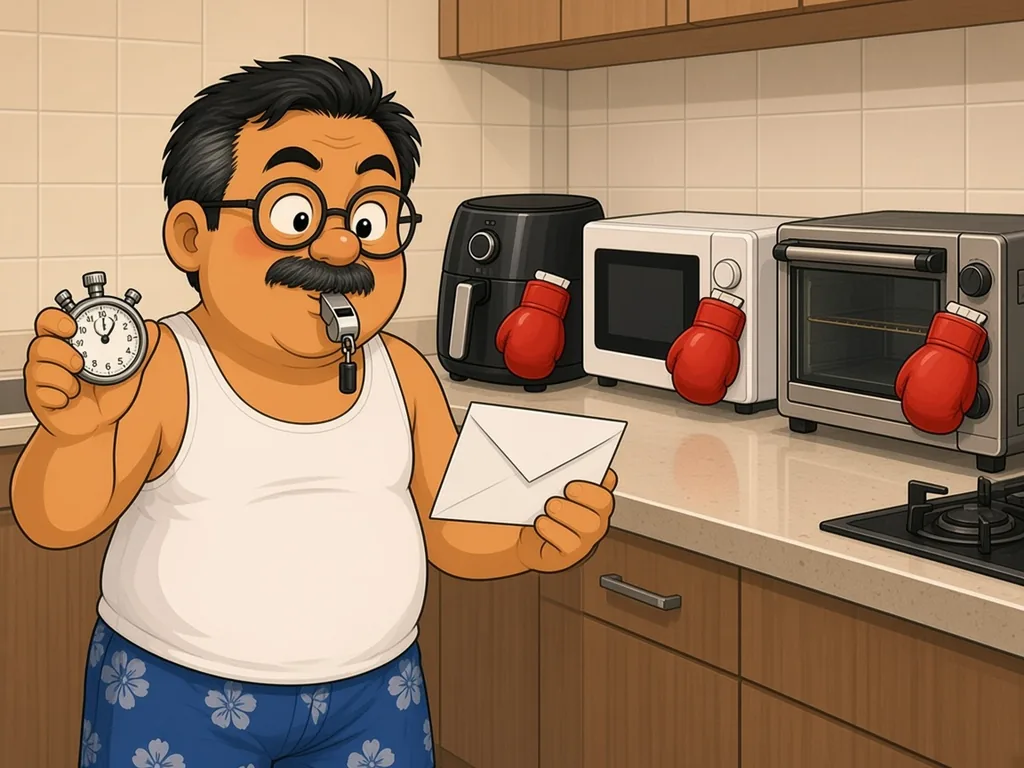
What each appliance actually is
- Air fryer. The US Department of Agriculture's Food Safety and Inspection Service (USDA FSIS) describes it as a countertop convection oven: a fan circulates hot air around the food. FSIS says a full-size oven can hold more food, while an air fryer cooks faster and generally uses less energy. It typically cooks in about 5 to 25 minutes at 350–400°F (about 175–205°C).
- Oven. The bigger box — more capacity, for larger batches, whole trays and baking.
- Microwave. USDA FSIS explains that microwaves cook unevenly and can leave cold spots, penetrate food only about 1 to 1.5 inches deep, and don't brown or crisp food.
Head-to-head
| Air fryer | Oven | Microwave | |
|---|---|---|---|
| How it heats | Fan-circulated hot air (a small convection oven) | Hot air in a larger cavity | Microwaves heat the food directly, unevenly |
| Capacity | Small; cook in batches | Largest of the three | One plate or bowl at a time |
| Crisping and browning | Yes | Yes | No — doesn't brown or crisp |
| Speed | Faster than a full oven (per FSIS) | Slower to heat up | Fastest for reheating |
| Energy for small meals | Recommended by US DOE over a large oven | Use for bigger loads | Recommended by US DOE over a large oven |
| Best for | Small batches of wings, fries, reheating fried food | Baking, big trays, family-sized roasts | Reheating leftovers, quick defrosting |
| Watch out | Don't overcrowd the basket | Bigger space to heat for a small meal | Cold spots — stir, rotate, let it stand |
Ah Huat's Kiasu Tip: These aren't really rivals. Ah Huat's rule: crisp → air fryer, big batch or baking → oven, reheat → microwave.
What about energy and running cost?
The US Department of Energy's Energy Saver Guide puts it plainly: "Use small appliances such as air fryers, multicookers, slow cookers, toaster ovens, electric pressure cookers, microwave ovens, or convection ovens for small meals rather than your large stove or oven. They will save energy and can save on cooling costs in the summer because they generate less heat." In a Singapore kitchen that's already warm, the second point is a bonus.
We don't publish a "this one costs X cents" table, because power draw depends on your model and how you use it. But you can estimate it yourself. SP Group lists the household electricity tariff for 1 October to 31 December 2026 as 31.16 cents per kWh including GST (28.59 cents before GST). SP Group says tariffs are regulated by the Energy Market Authority and revised quarterly, so check the latest rate.
Ah Huat's formula:
rated power in watts ÷ 1,000 × hours used × 31.16 cents = roughly the maximum cost
A purely hypothetical example (not any real product): an appliance rated at 1,500 W used for 20 minutes is 1.5 × ⅓ = 0.5 kWh, or about 15.6 cents at 31.16 cents/kWh. Treat the result as a rough estimate based on the rated power, not a measurement. Use the wattage printed on your own appliance's label or manual. For microwaves, USDA FSIS suggests looking inside the oven's door, on the serial number plate at the back, or in the owner's manual.
Food safety: the same rules, whichever box you use
Air fryer (USDA FSIS):
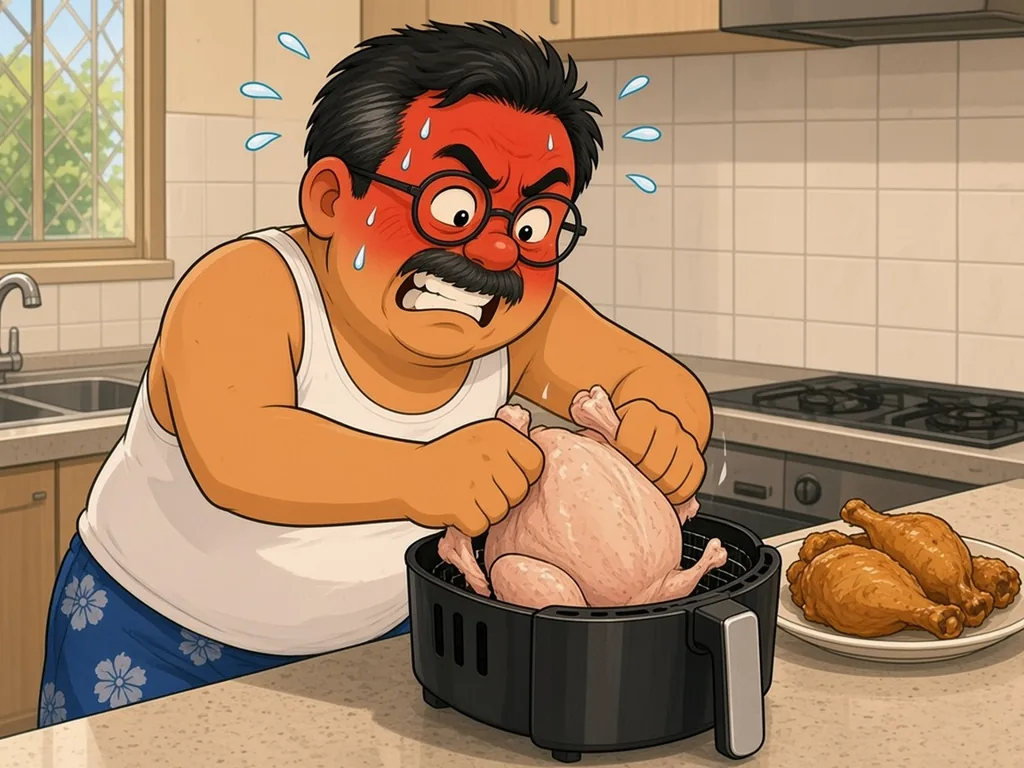
- Don't overcrowd the basket — cook in batches so hot air reaches all of the food.
- Use a food thermometer: poultry 74°C (165°F), minced meat 71°C (160°F), whole cuts and fish 63°C (145°F), with a 3-minute rest for whole cuts.
- Don't air fry raw, stuffed, breaded chicken breast products.
- Refrigerate leftovers within 2 hours.
Microwave (USDA FSIS):
- Cover and vent the food, and stir or rotate it partway through.
- Let it stand for at least 3 minutes after cooking to even out the heat.
- Reheat leftovers to 165°F (74°C), and check with a thermometer in several places because of cold spots.
- Use containers labelled for microwave use. FSIS lists cold-storage tubs (like margarine or yoghurt tubs), metal pans and foam containers as not safe to use.
Reheating leftovers (Singapore Food Agency): SFA's food safety tips say to reheat stored cooked food at 75°C and above for at least two minutes, not to reheat food more than once, and in the microwave to cover the food and reheat until it's steaming hot, using only microwave-safe containers.
For more on air fryer safety — SAFETY Mark, plugs and non-stick coatings — see Ah Huat's guide to choosing an air fryer.
Ah Huat's Kiasu Tip: Reheating leftover fried chicken? Microwave makes it soggy (no crisping, per FSIS). Air fryer brings back the crunch. Either way, heat it through properly — and only once.
So which should you buy?
- Small household, lots of fried food and reheating: an air fryer and a microwave cover most needs.
- You bake, or cook big family trays: you'll want an oven — an air fryer basket won't fit a tray of kueh bangkit.
- Mostly reheating tapau and leftovers: a microwave is the quickest.
- Counter space very tight: pick the one that matches what you cook most often, not what's trending.
Our picks
Paiseh, no pick yet. We haven't tested air fryers, ovens or microwaves hands-on. We're researching and comparing models from spec sheets and owner reviews before we recommend anything for Singapore homes. Rather than show a placeholder link, here's where our recommendation will go:
Product pick coming soon
We'll add a recommendation here once we're confident in it.
Pros
- Recommendation coming soon
Cons
- Not yet published — check back soon
Ah Huat's quick checklist before you buy
Screenshot this and bring it to the shop — Ah Huat would.
- What do you cook most: crispy, big batch or baking, or reheating?
- How many people? Air fryers need batches for a crowd.
- Measure your counter space and power points first.
- Note the rated wattage and do the maths: W ÷ 1,000 × hours × the latest SP tariff.
- Get a food thermometer — useful for all three.
- Microwave: cover, stir, stand; use microwave-safe containers.
- Leftovers: reheat to 75°C or steaming hot, only once.
Looking for more? Ah Huat has also done his homework on air fryers and rice cookers. Get these right and your home stays shiok — and so does your wallet.