
How to Choose an Air Fryer in Singapore (HDB & Condo Guide)
A kiasu, no-nonsense guide to buying an air fryer for a Singapore kitchen — what an air fryer really is, basket vs oven-style vs glass bowl, sizing for your household, the SAFETY Mark, power points and adaptors, non-stick coatings, and cooking food safely, with tips from Kiasu Ah Huat.
Updated 24 October 2026
Your neighbour posts photos of golden chicken wings in the block chat: "No oil one, air fryer!" Then the mall roadshow has a whole wall of air fryers in every colour, every size, all "limited-time promo". Your kitchen counter already has the rice cooker, kettle and microwave fighting for space. Do you need one? How big? Which type? Before you carry a big box home on the MRT, let's sort out what actually matters, so you don't kena con.
Your guide once again is Kiasu Ah Huat, our (fictional) everyday Singaporean who reads the fine print so you don't lose out. Look out for "Ah Huat's Kiasu Tip" along the way.
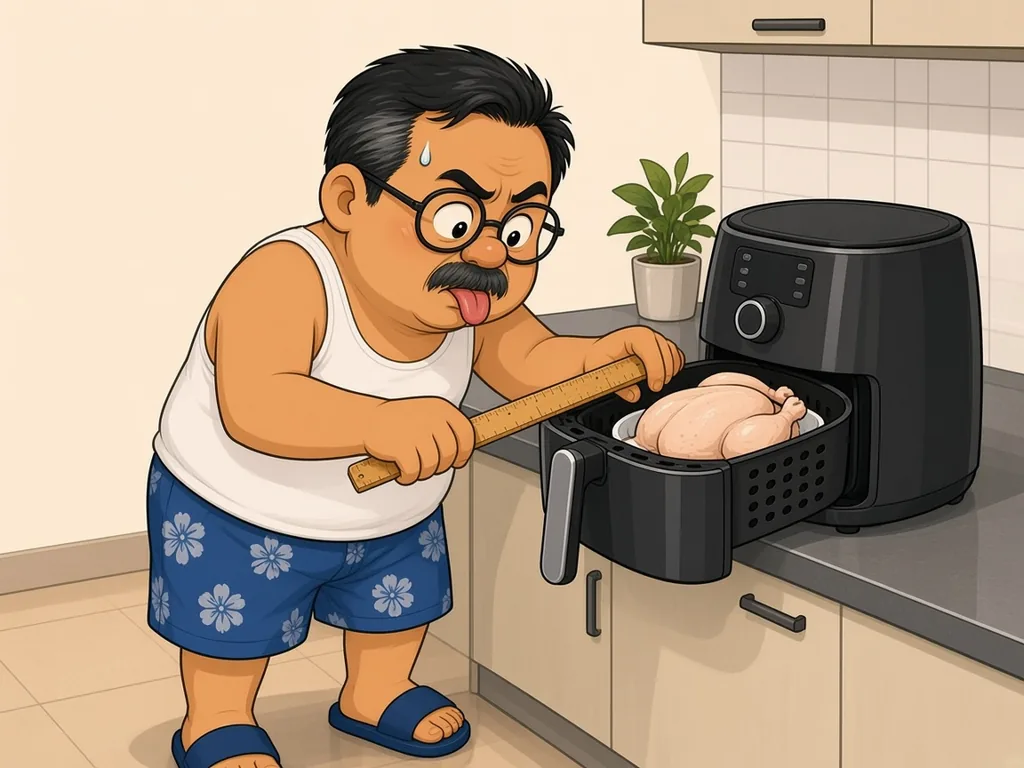
What an air fryer really is
Strip away the marketing and an air fryer is a small fan oven. The US Department of Agriculture's food safety agency (USDA FSIS) describes air fryers as essentially countertop convection ovens: a fan circulates hot air around the food. According to the same page, they cook faster and use less energy than a conventional oven, while an oven is larger and holds more food. Most foods take around 5 to 25 minutes at about 175–205°C (350–400°F).
So the honest pitch is: a quicker, smaller oven for small batches. It's not magic, and it does not replace every pot and pan in the kitchen.
The main types
| Type | What it looks like | Good for | Things to know |
|---|---|---|---|
| Basket | Pull-out drawer with a basket inside | Small batches: wings, fries, reheating | Limited room; don't overfill (USDA) |
| Oven-style | Small box with a door and one or more racks | Spreading food out in layers | Bigger footprint on the counter; check the internal space, not just the outside size |
| Glass bowl | Heating head sitting on top of a glass bowl | Seeing the food while it cooks | Singapore safety rules require the fryer part not to fall if the glass shatters (CPSO) |
Size: think batch, not "litres on the box"
USDA FSIS warns that air fryers generally don't have a lot of room inside. If you overcrowd the basket, hot air can't circulate properly, so food can cook unevenly or end up undercooked. Its advice: cook in batches and don't overfill.
That means the question is not "how many litres?" but "how much of what we usually eat can I spread out in one layer?" A couple cooking for two has very different needs from a family of five doing chicken wings for Sunday dinner.
Ah Huat's Kiasu Tip: Bring a measuring tape to the shop. Measure the basket or tray, not the outside of the machine, and picture your usual portion lying in one layer. If you must cook three rounds every night, you will regret buying small.
Also measure your counter. Check the space under your kitchen cabinets too, and read the manual for any clearance it needs around the vents.
Look for the SAFETY Mark
In Singapore, the Consumer Product Safety Office (CPSO) regulates 33 categories of "Controlled Goods". One of them is "toaster, grill, roaster, hot plate, deep fryer, wok and similar appliances" that use a heated medium such as air or cooking oil to prepare food. CPSO's information booklet for suppliers lists air fryers as an example in this category.
According to CPSO's SAFETY Mark page, Controlled Goods must be tested and carry the SAFETY Mark before they can be sold here. The testing covers hazards such as fire, electric shock and explosion. Each mark comes with a unique 8-digit registration number, which you can check on the register at go.gov.sg/safety-mark by model or registration number. Appliances with a 3-pin plug need two SAFETY Marks: one on the appliance and one on the plug.
CPSO's booklet also has a specific rule for air fryers with glass bowls: they must be designed so that the fryer portion does not detach or fall if the glass bowl shatters during use.
Ah Huat's Kiasu Tip: Online "overseas seller" listings are where Ah Huat becomes extra kiasu. Before checkout, type the model number into the SAFETY Mark register. Not listed? Don't buy, lah.
Plugs, power points and adaptors
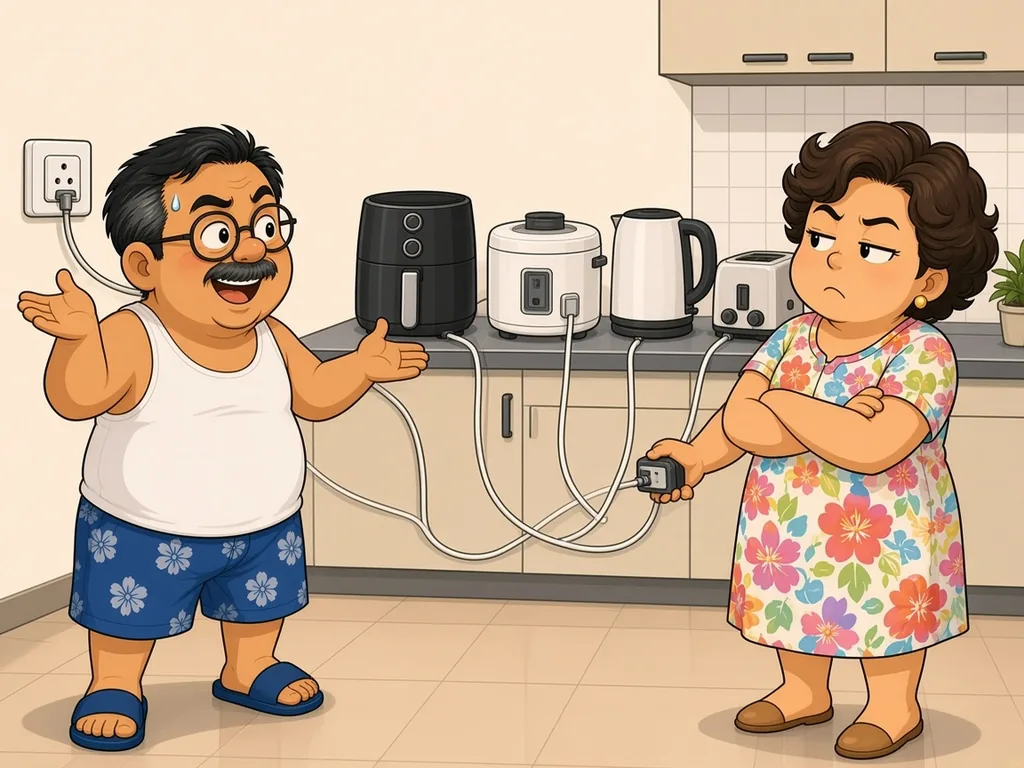
An air fryer heats up fast, so think about where you'll plug it in. CPSO's electrical safety tips say overloading wall socket outlets can cause fire hazards, and suggest installing additional ones if needed. Other tips from the same page:
- Pull the plug, not the cord, when unplugging.
- Stop using any appliance with a frayed or damaged cord.
- Keep liquids away from electrical appliances.
- Follow the manufacturer's instructions.
Multi-way adaptors and portable socket-outlets are themselves Controlled Goods, so they need their own SAFETY Mark. CPSO also explains that the 13A 3-pin fused plug is suitable for most household appliances, especially those with metal bodies, because of the earthing pin.
Ah Huat's Kiasu Tip: Check the rated wattage printed on the label, and look at what else shares that socket: kettle, rice cooker, microwave. If you need more points, CPSO says to consider installing additional ones; get a qualified electrical worker to do it. Don't load everything onto one socket.
Energy use (and no NEA tick label)
NEA's Mandatory Energy Labelling Scheme gives tick ratings only to specific appliances. According to NEA's MELS and MEPS page, these include air-conditioners, refrigerators, clothes dryers, televisions, lamps and water heaters. Air fryers aren't on the list, so you won't see a tick label on one. As USDA FSIS notes, an air fryer generally uses less energy than a full-size oven, but we haven't found an official Singapore source that compares models, so we're not going to make up a running-cost number.
Non-stick coatings
Many baskets have a non-stick coating, and people worry about "forever chemicals" (PFAS). The US Food and Drug Administration (FDA) says that in non-stick cookware, PFAS is polymerised and tightly bound to the pan, and studies show negligible amounts can migrate to food. Practical upshot: follow the manual on utensils and cleaning so the coating lasts.
Cooking safely: it's still cooking
An air fryer doesn't change the basics of food safety. USDA FSIS recommends using a food thermometer and cooking to safe minimum internal temperatures:
| Food | Safe minimum internal temperature |
|---|---|
| Poultry (wings, drumsticks, whole chicken) | 74°C (165°F) |
| Ground / minced meat | 71°C (160°F) |
| Whole cuts of beef, pork, lamb | 63°C (145°F), then rest 3 minutes |
| Fish | 63°C (145°F) |
USDA FSIS also says not to air fry raw, stuffed, breaded chicken breast products, and to refrigerate leftovers within 2 hours.
What about acrylamide? The FDA explains that acrylamide can form when plant foods such as potatoes are fried, roasted or baked at high temperatures. It caused cancer in animals at doses much higher than those in food, and the FDA is still studying the risk to people. Its tips: cook cut potato products to a golden yellow rather than dark brown, soak raw potato slices in water for 15 to 30 minutes before cooking (drain and blot dry first), and don't keep raw potatoes in the fridge.
Ah Huat's Kiasu Tip: "Golden, not burnt" — Ah Huat's new fries motto. And a cheap food thermometer is the best accessory you can buy. The air fryer's timer can't tell whether the chicken is cooked inside.
Our picks
Paiseh, no pick yet. We haven't tested air fryers hands-on. We're researching and comparing models from spec sheets and owner reviews before we recommend anything for Singapore homes. Rather than show a placeholder link, here's where our recommendation will go:
Product pick coming soon
We'll add a recommendation here once we're confident in it.
Pros
- Recommendation coming soon
Cons
- Not yet published — check back soon
Ah Huat's quick checklist before you buy
Screenshot this and bring it to the shop — Ah Huat would.
- Pick the type: basket, oven-style or glass bowl.
- Measure the basket or tray, not the outside. Can your usual portion lie in one layer?
- Measure your counter space and check the manual's clearance needs.
- Look for the SAFETY Mark on the appliance and the plug, and check the model on go.gov.sg/safety-mark.
- Glass bowl model? It must meet CPSO's rule that the fryer part won't fall if the glass breaks. Buy only SAFETY Mark-registered models.
- Plan the power point: no overloaded sockets, and use only SAFETY Marked adaptors.
- No NEA tick label for air fryers, so compare rated wattage on spec sheets.
- Get a food thermometer, and cook potatoes golden, not dark brown.
Looking for more? Ah Huat has also done his homework on rice cookers and food containers for your leftovers. Get these right and your kitchen stays shiok — and so does your wallet.
See also: Air Fryer vs Oven vs Microwave: Which One for Which Job in a Singapore Kitchen?