
How to Thaw Frozen Food Safely: Fridge vs Cold Water vs Microwave (and Why Not on the Counter)
Forgot to take the chicken out of the freezer again? A kiasu, fact-checked comparison of the safe ways to thaw meat, poultry and seafood in a Singapore kitchen — fridge, sealed pack in ice water, microwave defrost, or cooking from frozen — plus SFA's rules on refreezing and cross-contamination, with Kiasu Ah Huat.
Updated 24 October 2026
5pm. Ah Huat suddenly remembers the frozen chicken is for tonight's dinner. His "genius" plan: leave it on the kitchen counter, Singapore weather so hot, sure thaw fast one. Then Mrs Ah Huat walks into the kitchen…
Your guide once again is Kiasu Ah Huat, our (fictional) everyday Singaporean who reads the fine print so you don't lose out. Look out for "Ah Huat's Kiasu Tip" along the way. Today he learns — the hard way — that thawing has rules.
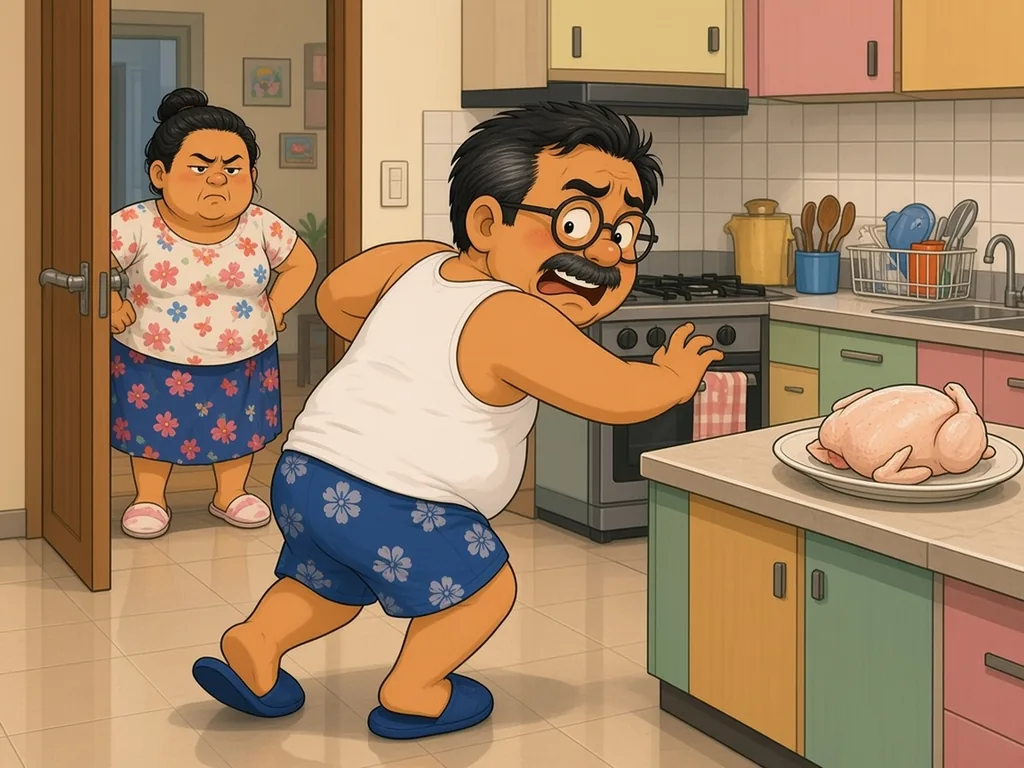
Why not just leave it on the counter?
The Singapore Food Agency's Guidelines on Thawing of Food (updated 27 September 2024) explain that when food is frozen, some bacteria in it may be inactive but are still alive. When it thaws and its core temperature rises, they can become active and multiply again. So SFA says frozen food should not be left to thaw at room temperature.
The US Department of Agriculture's Food Safety and Inspection Service (FSIS) explains the sneaky part in The Big Thaw: even while the centre of the package is still frozen, the outer layer can already be in the "Danger Zone" where bacteria multiply rapidly. FSIS says perishable food should never be thawed on the counter or in hot water, and must not be left at room temperature for more than two hours. SFA puts its "Temperature Danger Zone" at 5°C to 60°C.
Ah Huat's Kiasu Tip: "But the outside feels cold what!" Ah Huat, cold to the touch is not the same as safe. The surface warms up first.
The safe ways, compared
| Method | How | How long | After thawing | Ah Huat's verdict |
|---|---|---|---|---|
| Fridge / chiller | Chiller kept at 0–4°C (SFA); lowest shelf, on a tray or in a container | Slowest — FSIS says even about a pound (about 450 g) of ground meat or boneless chicken breasts needs a full day | Most forgiving: FSIS says poultry, seafood and minced meat stay good 1–2 more days, red meat cuts 3–5 days | Best, if you plan ahead |
| Sealed pack in cold or ice water | Leak-proof pack, fully submerged; SFA: ice water kept at or below 4°C, changed often. FSIS: change water every 30 min | FSIS: about a pound in an hour or less; 3–4 lb (about 1.4–1.8 kg) in 2–3 hours | Cook immediately | Good when you forgot |
| Microwave defrost | Defrost setting; stir or turn the food | Fastest | Cook immediately — some parts may start to warm up and cook | For small portions |
| Cook from frozen | Straight into the pot or oven | FSIS: about 50% longer than for thawed meat | Make sure it's cooked through | OK in a hurry |
| On the counter / in hot water | — | — | — | No. SFA and FSIS both say don't |
Method 1: In the fridge (the kiasu favourite)
SFA says to thaw in a refrigerator or chiller kept at not below 0°C and not above 4°C. Its general food safety tips say fridges and chillers should be at 4°C and below, and freezers at −18°C or below. SFA's thawing guidelines also say:
- Plan ahead — it takes time and space.
- Put raw food on the lowest shelf, or below cooked or ready-to-eat food, on a tray or in a container so drippings don't land on other food.
- Keep it in the fridge until you use it.
FSIS says a large frozen item needs at least a day for every 5 pounds (about 2.3 kg), and even small amounts can take a full day. Some parts of a fridge are colder than others, so times vary.
Method 2: Sealed pack in ice water (the "I forgot" rescue)
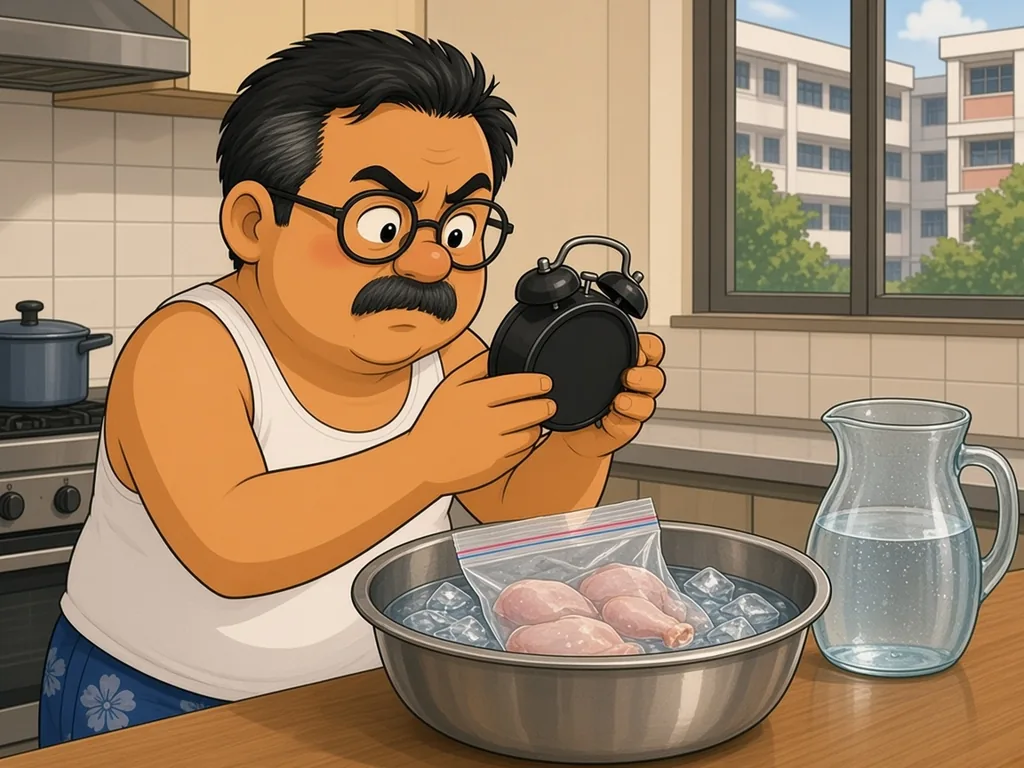
SFA's rules:
- Put the food in a clean, leak-proof package and keep it sealed — don't open it while thawing.
- Submerge it in clean ice water, changing the water often so it stays at or below 4°C.
- Never put the food directly in the sink or in water without packaging.
- Avoid drips and splashes onto other food, surfaces and utensils.
- Cook immediately after thawing.
FSIS adds that if the bag leaks, bacteria can get in and the meat can absorb water and turn watery.
Ah Huat's Kiasu Tip: Set a phone alarm every 30 minutes to change the water. Ah Huat uses the alarm clock. Same same.
Method 3: Microwave defrost (fast, but cook right away)
From SFA and FSIS:
- Use the defrost setting. FSIS's microwave cooking page says to remove the store wrapping first, and not to use foam trays or plastic wrap.
- Stir or turn the food to help it thaw evenly.
- Cook immediately — some areas may warm up and start cooking, bringing them into the danger zone.
- SFA says to avoid thawing large items in the microwave, and to clean the microwave thoroughly afterwards.
Is it fully thawed? Check before cooking
SFA says to thaw food thoroughly, because frozen or partly frozen food cooks unevenly — the outside may be cooked while the inside isn't. Check for ice crystals with your hand or a skewer. For poultry, the joints should be flexible.
Can I refreeze it?
Here the two agencies differ:
- SFA: cook thawed meat immediately and do not refreeze thawed food.
- FSIS: food thawed in the fridge can be refrozen without cooking, though with some loss of quality. Food thawed in cold water or the microwave should be cooked before refreezing.
Ah Huat's kiasu rule: follow SFA — thaw only what you need. For big packs, SFA's food safety tips suggest thawing the meat just enough (to about −10°C) to separate it, then deep-freezing it in individual portions.
Ah Huat's Kiasu Tip: The day you buy that big family pack of chicken, split it into dinner-sized portions before it goes into the freezer. Future you will thank you.
Never thaw it here
FSIS lists places to never thaw food: a garage, basement, car, dishwasher, plastic garbage bag, the kitchen counter, outdoors or on the porch. SFA adds: not on the floor, and keep raw meat away from cooked or ready-to-eat food.
Our picks
Paiseh, no pick yet. We haven't tested food containers or thawing gear hands-on. We're researching and comparing products from spec sheets and owner reviews before we recommend anything for Singapore homes. Rather than show a placeholder link, here's where our recommendation will go:
Product pick coming soon
We'll add a recommendation here once we're confident in it.
Pros
- Recommendation coming soon
Cons
- Not yet published — check back soon
Ah Huat's quick thawing checklist
Screenshot this and stick it on the fridge — Ah Huat would.
- Never on the counter or in hot water.
- Fridge at 0–4°C, freezer at −18°C or below.
- Raw meat on the lowest shelf, on a tray.
- In a rush? Sealed pack in ice water, change water often, cook right away.
- Microwave? Defrost setting, small portions, cook right away, clean after.
- Check for ice crystals; poultry joints flexible.
- Thaw only what you need — SFA says don't refreeze.
- Big packs: portion before freezing.
Looking for more? Ah Huat has also done his homework on food containers and air fryers. Get these right and your kitchen stays safe — and so does your stomach.